Location –
Dhamma Bhanu Vipassana Meditation Centre, Kyoto, Japan
[…] we found this velvet wall. It was dirt, but it felt like velvet. It was cool to see nature differently. It felt like the trees were pulsating sometimes, and we went over this look out trying to focus on individual trees and couldn’t. A patch of light through the trees looked purple. […] It was amazing. Just to live in the moment. – My best friend, R
I wasn’t on acid like the speaker of the quote who was describing an amazing hike, but experiencing a 12 day vipassana meditation course did feel rather out of body. That’s why I chose this gem as the header for this entry, because #relatable
At some point close to the fall of 2018, I applied and was accepted to a vipassana meditation course scheduled to start in early December 2018 located in Kyoto. The course is free (yeah, free!), I just needed to get myself to Kyoto. So, I used the flight voucher I mentioned in a previous post to go toward my plane ticket to Japan (thanks Delta!). I gave myself a few days before the course started and a few days after the course ended to see and wander Kyoto because #adventure
With my hostel booked, I boarded the flights for the short 18 hour journey from the eastern part of the US to Tokyo, and then took the Shinkansen from Tokyo to Kyoto. Thankfully, there was a clear view of Mount Fuji along the way.
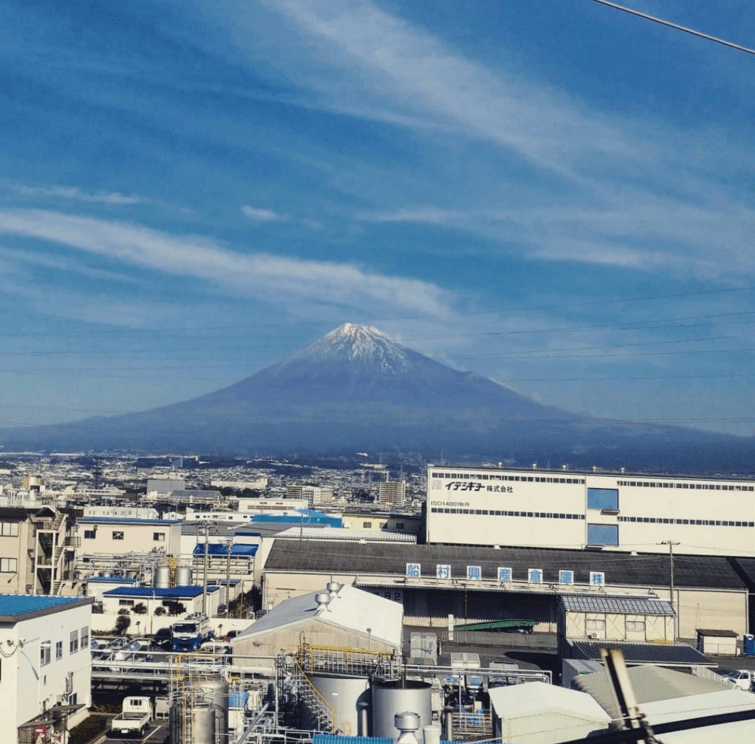
The first few days in Kyoto were spent doing the usual things. Sleep, enjoy sushimi, visit temples, navigate the subway, laundry, and repeat. During the wandering, in the back of my mind I knew I was going to be silent for over a week. My thoughts were preoccupied with “What am I doing?” “Do I really want to do this?”
Not knowing what to expect from the meditation course and reading so many different experiences from others, I must admit that I was a bit excited and a bit nervous. The journey to the meditation center in a rural part of Kyoto was to be timed meticulously so that the center would pick up participants on time. With everything in Japan running exactly on time, I wasn’t concerned about missing the buses and trains. It was me that I was making sure wasn’t missing any steps.
The night before I was to leave for the center, I sat in the hostel common area reviewing the email information from the center that I printed out, in case I didn’t have service during the trip. Just as I finished reading through the information, a woman from Australia called Janet sat next to me. I am guessing that she saw my printed information, because she then mentioned that she had been to a course at a vipassana center in Australia in the late 1970’s. She offered to share her experience and invited me along to view the temples at night.
Temples in the daylight are amazing. The temples at night are quite a beautiful sight.
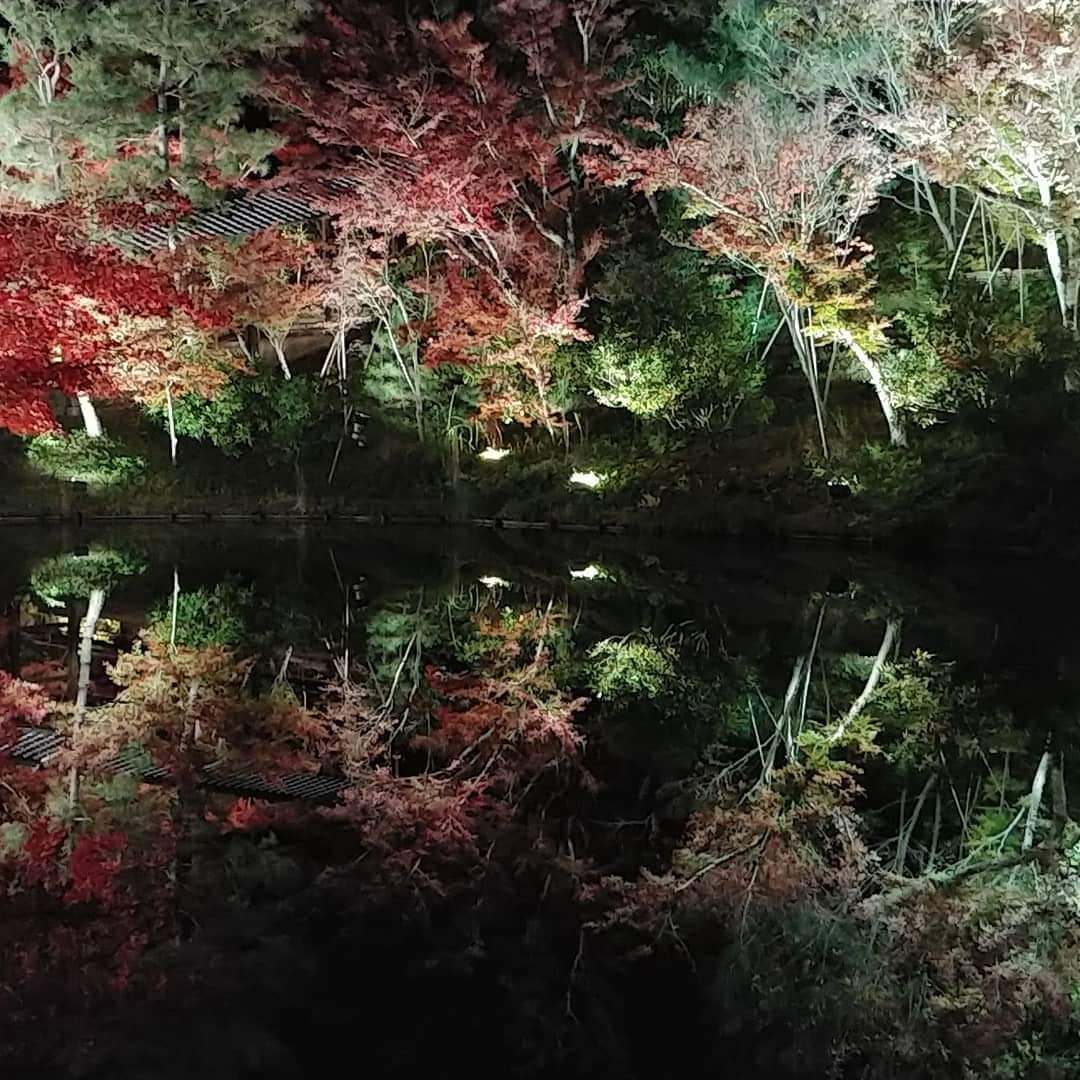
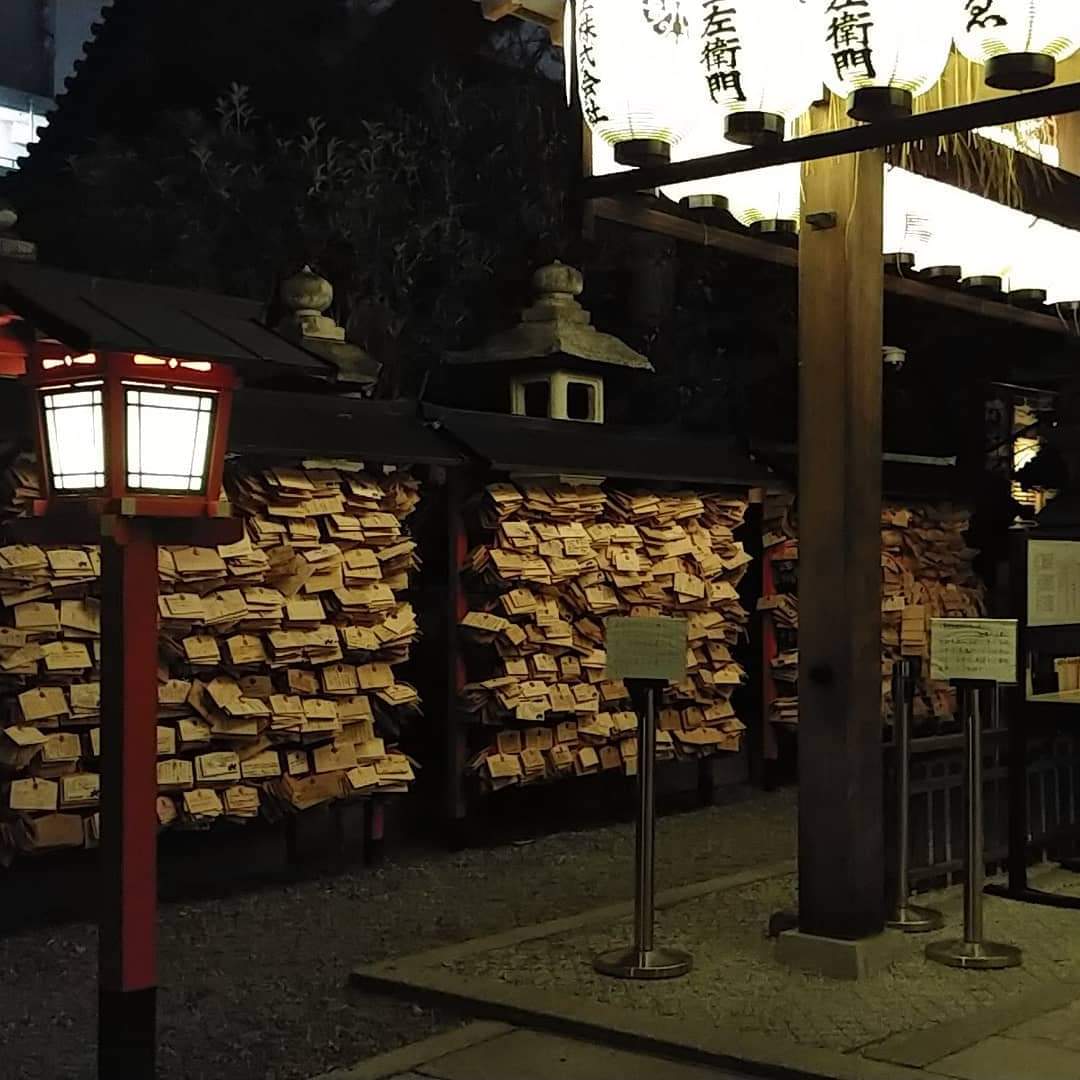
Sharing a beer, okonomiyaki in a little restaurant hidden away on a side street, viewing beautiful temples, and listening to the stories shared by this most random person. It was an amazing time and after hearing her describe the course as “the most painful and freeing experience of her life”, I was pumped to do this course, more than ever.
My meticulously timed journey was successful. I made it to the Dhamma center and started things off with handing over everything but my clothes and hygiene items to the staff. For the next 12 days, we would have nothing to read, listen to, look at (yeah, no phones), no talking to anyone, no eye contact. We would be spending 10 hours a day on 10 of the 12 days meditating in complete silence. The only times you could talk is to the house manager or course assistant teacher. Otherwise, no communication of any kind, verbal or non-verbal. This is known as Noble Silence.
The first few hours of the first day (day zero) and the last day (day 11) are meditating. We only get breakfast and lunch. There is tea in the evening with two pieces of fruit, for new students only. To start each day, the house manager bangs a gong at 4 am or what I called, Gong Thirty.
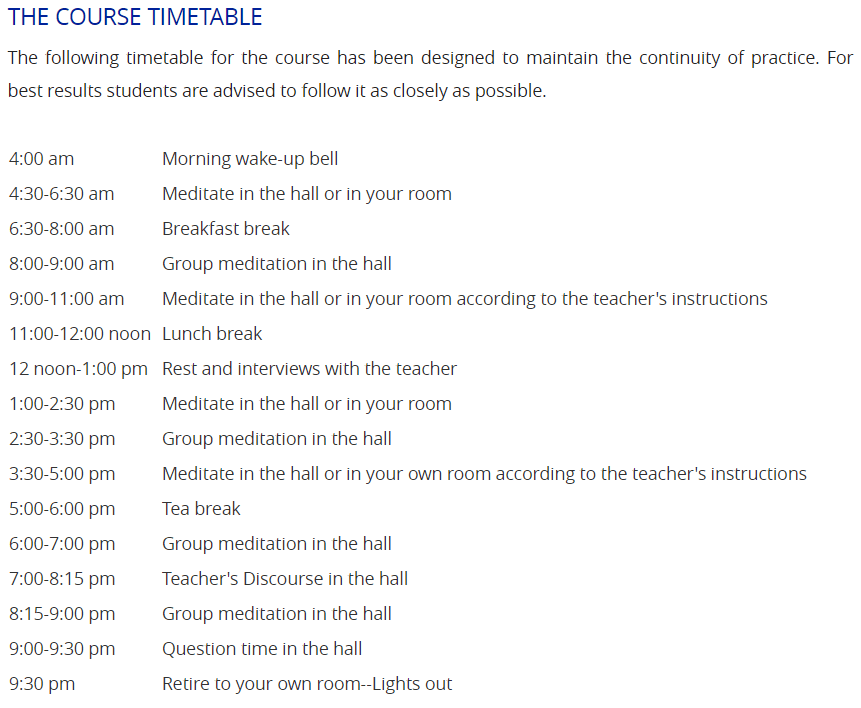
Each day starting from day 1 to day 10, the daily schedule was as follows:
Day Zero
After handing in all of my worldly possessions, I got my bed assignment. Luckily, I got a room with a bed. Some people were given assignments of cots on the floor. I later realized that it wouldn’t matter what sleeping arrangement you had because at the end of each day, we were all exhausted and fell right asleep.
After the gong rang that evening, we all filed into the meditation hall and received our mat assignments. Each mat had two cushions and a blanket. We then watched a video of SN Goenka (the head teacher of the course) and started our first meditation and Noble Silence. In a confused daze and in anticipation for the coming week, we all walked back to our rooms, got settled in for the night, and headed to bed.
At some point between check in and lights out, we were fed. This was the only time during the course that we got dinner (delicious mix of Japanese and Korean vegetarian food). Just wanted to point that out.
Days One to Three
As it turns out, staying silent is the easy part. The focus is the hard part.
The daze from the first day, or day zero, wears off fairly quickly when you hear the gong bang at 4:00 AM. You’re almost in a trance when you start meditating for the day. The first three days are spent learning breathing techniques, adjusting your cushion so that you’re comfortable, adding knee pillows for comfort, breathing, adding more knee pillows, and breathing. Did I mention breathing and adding knee pillows? It becomes a routine, and you quickly start to notice your body and how you feel. That becomes the overall focus, scanning the body. I was physically in so much pain that I was trying to focus more on releasing that pain. But then I kept thinking about the pain. I started to understand what Abraham Hicks meant when they talk about banging the drum. The more you think about not thinking about a something, the more you think about that something. The more I tried to not think about the pain, the more I thought about the pain. So, I focused solely on my breathing.
I really started to look forward to the discourse at the end of every day. I found that Goenka was actually quite funny and very relatable. He recognized how painful it was and then explained why it was painful. It helped me better understand that the pain is progress and that I’m doing the method correctly.
“Anything that arises in the mind will manifest itself as a sensation on the body; if you observe this sensation you are observing both the mind as well as matter.” ― S.N. Goenka
Days Four to Six
Everything is routine now. I’m really starting to enjoy my new home and it’s becoming a part of me. I’m becoming comfortable, and that’s important to know. During these three days, this is when you hit the peak before the breakthrough. The first three days you’re allowed to move and adjust your body to get comfortable during the meditations. But starting on day 4, you are no longer allowed to move and your eyes are to stay closed. So, it’s very important that you become comfortable in the environment. Also, this is where the real pain starts. This starts as misery in the mind and manifests in the body. I started thinking about things that I had completely forgotten about from childhood and parts of my adulthood. There were a lot of emotions, a lot of it anger. The goal during this time is to not name or label the feeling but only to acknowledge it. Observe it but don’t participate in it. That means when the excruciating pain would hit my knees (for me, this is where it manifested most), I would repeat in my head “I see you.” And then I would breathe and look at another part of my body through my mind’s eye. This did not make the pain stop at first, but it made it more bearable because I would detach. At the end of each session, we all look like zombies walking out of the meditation hall. Everyone’s legs were hurting. We would all be stretching in the hall or walking around the property. The struggle and progress was real, for everyone.
“Work diligently. Diligently. Work patiently and persistently. Patiently and persistently. And you’re bound to be successful. Bound to be successful.” ― S.N. Goenka
Day Seven
Day seven was a big day for me. First, I broke noble silence. I was in the bathroom after breakfast getting ready to brush my teeth. When I got my toothbrush out, it flew out of my hand as if someone had taken it and landed bristles down in the trash bin. Looking at my former toothbrush perfectly positioned in rubbish, I calmly said “Well, shit,” out loud. I then looked around the bathroom and there was only one other person in there. She was brushing her teeth, stopped when she heard me, we looked at each other. She went back to brushing her teeth, and I left to find the course manager so that I could get another toothbrush.
Later that day, after lunch, I gathered myself for what I thought would be another painful meditation session. Shortly after the meditation began, the pain started. I practiced the techniques of detaching and forgiveness and letting go of emotion. Suddenly, the pain just vanished. I was shocked but happy. I was able to sit the remainder of the session without pain, and the pain never did return. It was liberating.
“When I observe myself and find that I am generating anger, ill will, or animosity, I realize that I am the first victim of the hatred or animosity I am generating within myself. Only afterwards do I start harming others. And if I am free from these negativities, nature or God Almighty starts rewarding me: I feel so peaceful.” ― S.N. Goenka
Days Eight to Ten
After the breakthrough of day seven, I was truly able to enjoy the process of peaceful, mindful meditation. Anytime a thought came in, I observed it and let it pass through. I didn’t dwell on it, ruminate on it, or hold on to it. My mind, for the first time, was clear. I could finally breathe, detached from holding on to emotion.
During this time, the message Goenka spoke of feeling a feeling and letting it go as to not create misery started to resonate a lot more. Likely because I was able to hear with a clear mind and clear heart. He said that holding onto a memory or feeling of happiness causes us to long for that feeling when it dissipates. This is what causes misery. The more we long and chase a feeling, the more misery we carry. Same with attachment to objects. If we attach to objects, those objects own us. They are things and come and go, just like feelings. This message changed my life.
Grasping at things can only yield one of two results: Either the thing you are grasping at disappears, or you yourself disappear. It is only a matter of which occurs first. ― S.N. Goenka
Day Eleven
The last day of the course. We may not have spoken during the course, but we were all bonded by experience. When we were finally able to talk to each other, the conversations flowed as if we had known each other for a long time. There was and wasn’t a language barrier. A lot participants, the majority, spoke Japanese, only some spoke English as well. There were a handful of foreigners who spoke English, but even still there was laughing and sharing of experiences, exchanging Facebook names, etc. As we cleaned up the dining hall and meditation hall before we were taken back to the bus stop to start our separate journey to wherever, the air was light, our faces and smiles were brighter, and we all felt lighter. We unpacked so much. We were all so grateful.
Vipassana is the art of living. Not the art of escaping. ― S.N. Goenka
Afterward to Present Day
The world was tangibly different, because I felt different. For the first 24 hours after leaving the course, the sound of the world, trains, people, announcements in stations, were louder than normal. You don’t realize the power of silence until you sit with it for some time. But wandering Kyoto the days after the course, I stopped during a walk in the Gion part of the city and realized that I wasn’t thinking of anything. I stood looking at the trees and beautiful buildings and thought of nothing. As I turned around to go back another way, I saw a Geisha. It’s rare that Geisha’s just show up like this even though Gion is the geisha district. She just happened to be hired for pictures by the woman in the photo with her. Pretty amazing, really.

Since the course has ended and I have established my kind of routine in life (which is mostly wandering and figuring things out), I have been able to keep the detachment practice of not holding on to emotion. I allow myself to feel the feeling, but I don’t hold on to the feeling. This is easier on some days than it is on others. But moving beyond an emotion is easier now.
Some people who see me respond instead of react to something think of me as a robot. Really I am just at peace with where I am. This course made a huge impact on my life. It helped me to move through trauma of the past and help me get through trauma that I encounter now much easier. Plus, when people try to project their feelings onto me, as people do, I stay balanced within and think, “that’s not my bag to carry”. Thanks to the pain I endured and released, the things I confronted that I long buried, and the commitment to myself, I am not attached to the feeling but instead more attached and connected to myself.
I fully recommend the course to anyone, if it resonates or calls to them. Research it, read, and understand where you are in your life. It’s free and what you gain from it is priceless.
Appreciate you all taking the time to enjoy the journey with me.
May all things be happy, my friends.
- Interested in the course? Learn more about it here.
- Have additional questions for me about my experience? Email me using the contact form.
- Check out additional pictures from my travels in Kyoto in the Digital Postcards.
 Wander Often